At a glance

AI for Nurses is a three-course Coursera Specialization from the Duke University School of Nursing, funded by a Johnson & Johnson grant. It helps registered nurses, nursing assistants, LPNs, and nurse administrators connect AI concepts to everyday clinical practice, with a focus on quality and safety. As Senior Learning Experience Designer and Project Manager, I led the design and development with three faculty, from survey data and a co-design session with nurses through launch in September 2026.

Launched
September 2026
Credit
Up to 9 nursing CE hours
Scope
3 courses, 14 modules
Next
Second year funded
01 · Try the learning

Three learning examples

Each module introduces a concept, gives learners a way to explore it, and connects it to practice. I used ChatGPT, Claude, and Claude Code to support the design. You can try the first two activities below as a learner would.
01Comparing two kinds of AI
Learners rerun a fall risk score and a generated discharge summary to see which one changes, before the terms predictive and generative are introduced.
Live activity · try it here
02Exploring what a model uses
Learners change what a model receives and watch its output respond, including what a nurse knows that the model doesn’t.
Live activity · try it here
03Practicing a clinical decision
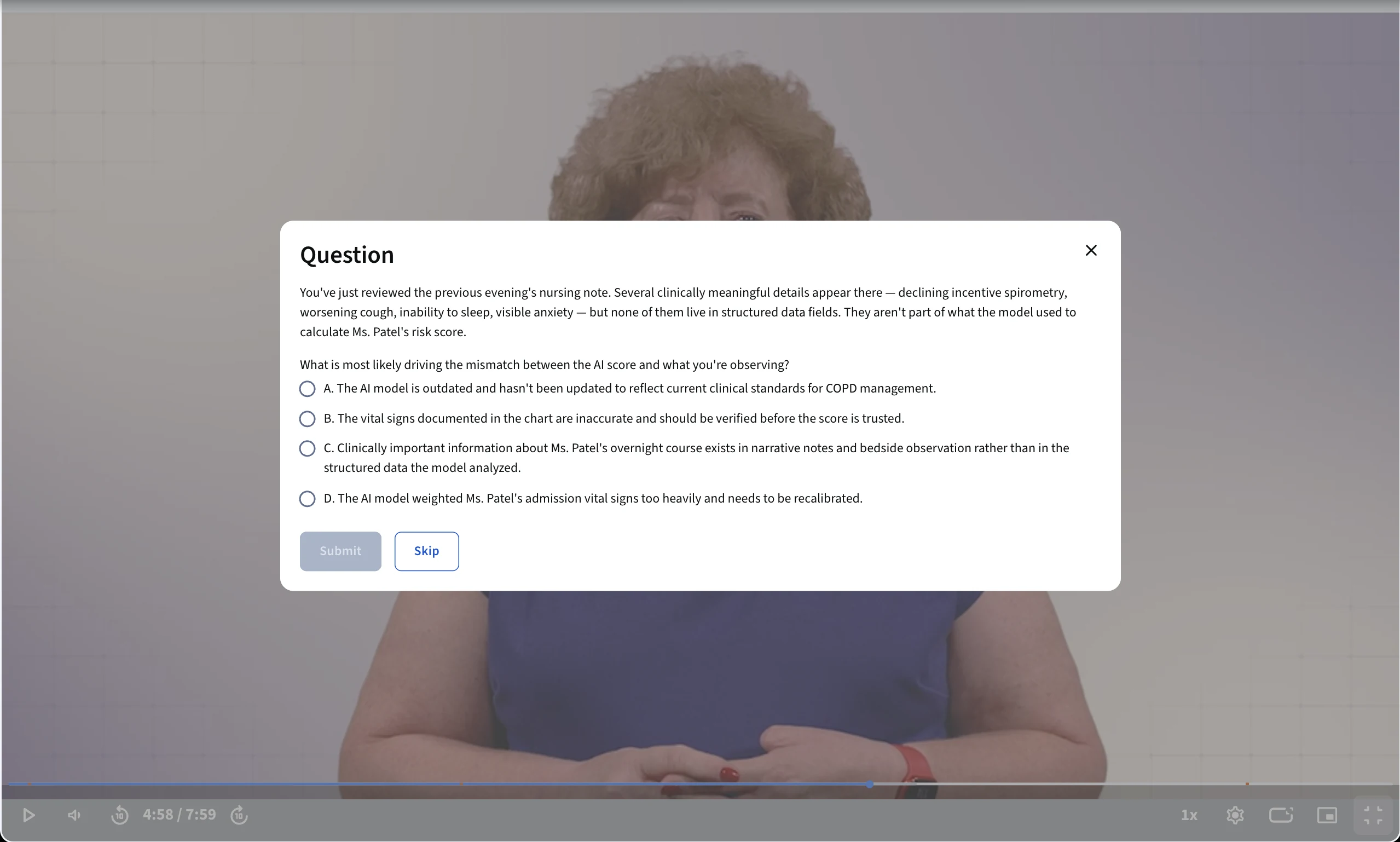
Five guided clinical cases pause mid-video so learners decide what they would do, then reflect on their reasoning.A case-study pause point from the course
02 · Key decisions

Three design decisions to support learning

  1. Start from what nurses already see on a shift.In a co-design session I developed and facilitated, registered nurses described AI as something flagged, summarized, prioritized, or triggered. Those four patterns carry through all three courses.
  2. Build from seeing, to evaluating, to applying.Course 1 helps nurses recognize where AI appears in practice, Course 2 helps them evaluate what an output is telling them, and Course 3 has them practice using that understanding in clinical situations.
  3. Pair short expert videos with practice at a clinical moment.Faculty videos stay under seven minutes. In Course 3, case study videos pause three times so nurses make a real-time clinical judgment, and each course ends with a capstone drawn from the nurse’s own workflow.
03 · Details

Want the details?

About the project, courses, and team

This project started with a gap. Faculty at the Duke University School of Nursing noticed that as more healthcare tools become AI-enabled, nurses are feeling pressure to learn and adapt on the fly. Often a new AI tool appears in their workflow with minimal explanation of how it got there, what it does, or how they should engage with it. Other times, nurses have been working with AI all along, but it isn’t obvious; it just feels like part of their systems.

With support from a Johnson & Johnson grant, I led the design and development with three School of Nursing faculty for the first of three planned Specializations on Coursera. With that gap in mind, we co-designed a three-course series that gives nurses a foundation for working with AI.

We kicked off in September 2025, and the Specialization launched in September 2026.

The courses and faculty leads
Course 1 · Seeing AI in Nursing PracticeLed by a nurse scientist · 4 modules, about 3 hours
Course 2 · Evaluating AI in Nursing PracticeLed by an engineer and data scientist · 4 modules, about 3–4 hours
Course 3 · Applying AI in Nursing PracticeLed by a family nurse practitioner and educator · 6 modules, about 3–4 hours
Design and media team
MeSenior Learning Experience Designer and Project Manager
DesignLearning Experience Designer
MediaMedia Designer and Media Producer
The learning progression and objectives

Survey data from working nurses and conversations with partners shaped a progression I shared early with stakeholders. Because the Specialization is accredited for nursing continuing education, accreditation requirements also informed design decisions along the way.

Up to 9 credit hoursContinuing education for nurses through Duke University Health System Clinical Education and Professional Development, accredited by ANCC, ACPE, and ACCME.
Learners will be able to
Course 1 · Seeing AI in Nursing PracticeRecognizewhere AI appears in nursing practice
  • Identify common AI tools used in nursing workflows.
  • Explain how AI systems transform clinical data into outputs.
  • Distinguish between rule-based systems, machine learning models, predictive AI, and generative AI.
  • Describe how healthcare organizations select and govern AI tools.
Course 2 · Evaluating AI in Nursing PracticeEvaluatewhat an AI tool’s outputs are telling you
  • Explain how AI models learn from historical healthcare data.
  • Interpret common AI outputs with appropriate confidence and skepticism.
  • Identify situations where AI tools may perform poorly.
  • Recognize how bias can emerge from historical data and healthcare system patterns.
Course 3 · Applying AI in Nursing PracticePracticeusing that understanding in clinical situations
  • Apply the AI-SBAR framework to interpret and communicate AI-informed clinical concerns.
  • Integrate AI outputs with patient assessment, clinical context, patient goals, and nursing judgment.
  • Respond appropriately when AI outputs align with or conflict with bedside observations.
Four ways AI shows up in nurses’ workflows
In a co-design session that I developed and facilitated, registered nurses described AI as something flagged, summarized, prioritized, or triggered. These patterns carry through all three courses. Select one to see the vocabulary it introduces.
A score fires, an alert appears, or a Best Practice Advisory surfaces. The system detected a pattern and drew your attention to it.
What nurses see
Deterioration alertFall risk scoreSepsis BPA
Vocabulary it leads to
Course 1Predictive AI · Machine learning · Inputs & outputs
Course 2Features & labels · Training data · Sensitivity & specificity
The system wrote text from documented information: a drafted note, a discharge summary, an overnight synthesis. The system produced language for you to review.
What nurses see
Discharge summary draftProgress noteAfter-visit summary
Vocabulary it leads to
Course 1Generative AI · AI model vs. tool
Course 2Self-supervised learning · Large language models · NLP · Unstructured data
Your patient list is reordered, a message inbox is ranked, or a rounding order is suggested. The system shaped what information reaches you first.
What nurses see
Reordered patient listRisk-ranked roundingPrioritized inbox
Vocabulary it leads to
Course 1AI model vs. tool · Inputs & outputs
Course 2Training data · Features & labels · Supervised learning
A protocol populates, a care plan initiates, or a checklist appears. A threshold was crossed and the system started a pathway on your patient’s behalf.
What nurses see
Fall prevention protocolSepsis bundleSkin care plan
Vocabulary it leads to
Course 1Rule-based systems · AI governance
Course 2Sensitivity & specificity · Supervised learning
Course 3AI-SBAR
Seven activity types and the capstones
Lessons pair a short expert video with readings that build vocabulary and connect it to real tools, then check understanding along the way.
Explore
Check
Apply
ExploreExpert videosDuke School of Nursing faculty introduce concepts in clinical language, in videos under seven minutes. In Course 3, case study videos pause three times so nurses make a real-time clinical judgment.
Project timeline, from kickoff to launch
I led project management through writing, recording, activity development, learner testing, and partner review. Partners funded a second year, and we’re now developing a new Specialization.
Sep 2025Project kickoff
Oct–Nov 2025Understanding learners’ needs and testing early activities
Dec 2025Script writing and recording prep
Jan–Feb 2026Media recording and video visual design
Mar 2026Co-design session with nurses
Apr–May 2026Interactives, assessments, and supplemental materials
Jun 2026Course build and learner testing
Jul 2026Final partner review, CEUs approved
Sep 2026Launch
04 · Ask me

Still curious? Ask me!

← PreviousSpace MedicineNext →Interactivity Generator