At a glance

Let’s Talk Digital You is a for-credit, interdisciplinary Duke course in the University Course series, open to undergraduates in any major, mostly in their first year. It explored how today’s technologies work and the ethical questions they raise, as a hybrid, semester-long course in Canvas. As Senior Learning Experience Designer and Project Manager, I led the planning, curriculum mapping, and design strategy with two lead instructors, and managed the project from April 2023 through the debrief in May 2024.

Ran
Spring 2024
Teaching team
2 lead instructors, 12 guest lecturers, 10 TAs
Structure
16 weeks, paired tech and ethics themes
Result
Growth in ethical reasoning and digital literacy, seen in reflections, final projects, and course evaluations
01 · Inside the course

Browse Weeks 4 and 5

One two-week module, “I Made Generative Art,” as it appeared in Canvas: a technical week, then an ethical week on the same topic. Select an item to open it.
Weeks 4 & 5: I Made Generative Art: Exploring Generative Art through AI ModelsModule mockup · names and student work removed
Monday, January 29 · Week 4 · TechnicalMonday, February 5 · Week 5 · Ethical
Generative Art through AI, Week 4 banner
Week 4A Technical Perspective on I Made Generative ArtLecture · January 29, 2024

What transforms when the brushstrokes of a canvas are encoded into pixels on a screen? How does the essence of visual culture morph as we shift from the analog to the digital? This week, we will discuss the evolution of visual culture, probing the dichotomy between the physicality of analog and the abstraction of digital media.

By the end of this week, you will be able toCompare the characteristics of analog and digital media, using examples to explain how each medium shapes viewers’ perceptions and an artwork’s cultural value.Explain how an analog artwork is converted into a digital format, identifying what changes in its materiality, scale, and representation of visual information.Identify how neural networks and Stable Diffusion represent and process visual data.Describe how artists use these methods to create new forms of visual expression.
  1. Before class
    No readings or pre-class assignments this week.
  2. In class
    Lecture by a professor of the practice in Art, Art History & Visual Studies and a technology company co-founder, followed by the lab in EdStem with your small group.
  3. After classDue Feb 2
    Draft a 300–500 word technical reflection, share it in your section’s discussion, then take the weekly self-assessment.
Generative Art through AI, Week 4 banner
Week 4 · LabText-to-image toolsEdStem · In class, led by TAs
Overview · 1 of 6

In this lab you will work through a series of exercises in which you will explore how text-to-image tools like Stable Diffusion work. As you work through these exercises, you will be asked to consider a range of thought-provoking questions that will help you develop a better appreciation of the kinds of relationships between text and image that these models have learned.

By the end of this lab, you will be able toDescribe the complex relationships between text prompts and output images in the case of text-to-image toolsFormulate more critical questions about dataset curation and its real-world effectsExplain the importance of labeling
Lab formatYour TA will lead you through the information on the following pages in a live lecture/discussion format. A text version is provided so students can think ahead about the questions and review the material throughout the semester.
Training data · 2 of 6“Ceci n’est pas une pipe” – René Magritte

The ability to translate text into visual images is a remarkable recent achievement. In the following series of activities, you will explore the ability of a state-of-the-art text-to-image tool to create realistic images using only text prompts. By critically evaluating the output, you will try to develop a better understanding of the kinds of relationships between text and images that the model has learned.

An important (and often uncelebrated) reason for the success of recent AI models is the creation of gargantuan training datasets. For example, the LAION-400-MILLION open dataset has been used to train various text-to-image models. As the name indicates, this is a massive dataset made up of 400 million image-text pairs.

Key questionA model is only as good as the data used to train it. But if a training dataset becomes so big that it’s composed of literally hundreds of millions or even billions of examples, how do we ensure the quality of each example?
Write the prompt · 3 of 6

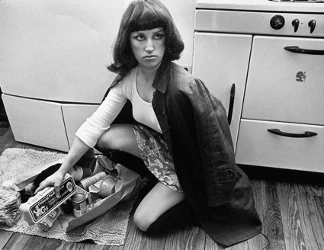
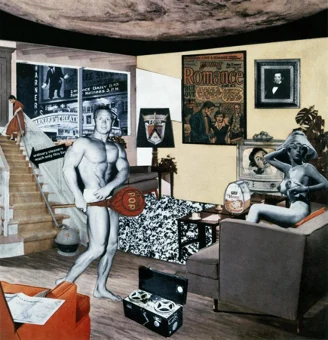
For each of the images below write a language prompt you think would yield the image. Discuss as a group.

Black-and-white film still of a woman crouched on a kitchen floor beside groceries
1 · Art imageCindy Sherman, Untitled Film Still, 1978
AI-generated image of an older man in a white puffer coat
2 · Deep fake imageA generated image presented as a photograph
Pop art collage of a 1950s living room
3 · Aesthetic / genre imageRichard Hamilton, Just what is it that makes today’s homes so different, so appealing?, 1956
Discussion guideHow do the various cultural backgrounds inform different readings/prompts for these images?How can language be employed to describe the images, the contents, the politics?What visual material would need to be used to train a system capable of generating these images? Where could it come from?Who should be responsible for labeling it?
Test for bias · 4 of 6

In this section you will experiment with the Stable Diffusion tool on the Hugging Face website. Design and enter a prompt to generate an image depicting a specific profession or role, in an important action.

Prompt patternA [profession] [performing an appropriate action]
“A doctor consulting a patient”“A landscaper trimming a tree”“An inmate exercising in prison”“A sanitation worker cleaning a toilet”
Questions to guide your experimentationWhile keeping the profession type are you able to change the representation of the figure?What words can you use to move away from stereotypes presented in the original image?How do images perpetuate cultural stereotypes?Who selected the images used to train this AI?What alternative images exist but may not be discoverable, shared or incorporated into training data sets?What does representation look like on the internet?
Make art · 5 of 6

In this section you will test the ability of generative AI to create compelling, important artwork images. Using Stable Diffusion study the creation of emotive artwork.

01EmotionCan you create an image that conveys emotion?What is emotion, and how do you work through prompts to create it?
02BeautyCan you create an image that has Beauty?What is beauty?
03CritiqueCan you create an image that critiques culture?How can imagery critique the political, economic or social condition?
Wrap up · 6 of 6

In this lab we have discussed the practical problems associated with creating gigantic training datasets and the subjective challenges of deciding what the labels should even be, a problem which is especially acute in the case of labeling works of art. In this final activity, you will go through an interactive essay which explores the challenges of deciding what the labels should be, even for ostensibly “simple” images.

What nextWrite a 300–500 word reflection on your initial blog post ideas, drawing from your experiences in the lecture and lab, then share it in your section’s discussion. Return to Canvas for the weekly self-assessment.
Generative Art through AI, Week 4 banner
Week 4 · DiscussionTech ReflectionReply in the discussion · Due February 2, 2024

This reflection post gives you the opportunity to 1) start drafting your blog post 2) prepare for next week’s material.

Questions to considerWhat lingering questions do you have that you hope get covered next week?Is there further research you’d like to do independently for your blog or sources you’d like to share?

Please make sure to complete the full lab for this week before adding a reflection post to this discussion. Once you post your reflection, you are welcome to read your peers’ responses and respond to posts that spark your interest.

Student postsEach student shared a reply and a link to their Sites@Duke blog. Posts are not shown here for privacy.
Generative Art through AI, Week 4 banner
Week 4 · QuizSelf-AssessmentGraded quiz · 10 pts · Due February 2, 2024 · Unlimited attempts

Please complete this self-assessment to receive credit for this week’s assignments that you completed. You will receive full-credit for the activities you completed, but you will not receive credit for the activities you did not.

You can submit this self-assessment multiple times, so if you’re able to complete an activity after the initial deadline, you can resubmit this assessment to revise your grade.

Generative Art through AI, Week 5 banner
Week 5An Ethical Perspective on I Made Generative ArtLecture · February 5, 2024

How are we as humans to think about the advent of AI-generated art? Is it “art” in the sense of the word to which we are accustomed? If not, why not? This week, we will discuss the social, ethical and human implications of the latest development in the evolution of visual culture that we began discussing last week.

By the end of this week, you will be able toEvaluate whether AI-generated works meet different definitions and purposes of art, supporting your position with examples and responding to an alternative perspective.Analyze how AI-generated art challenges ideas about human creativity, authorship, and identity, using specific examples to explain its social and ethical implications.
  1. Before class
    Two readings: a New York Times article and a Harvard Gazette piece on AI-generated art.
  2. In class
    Lecture by a professor of literature, followed by the case study discussion with your small group.
  3. After classDue Feb 9
    Write a 1,000–2,000 word blog on Sites@Duke that connects the technical and ethical weeks, share the link, then take the weekly self-assessment.
Generative Art through AI, Week 5 banner
Week 5Generative AI and Art: Ethics HypotheticalCase study · In class, in small groups led by TAs

As part of an effort to increase undergraduate interest in their programming, the Nasher Museum of Art is hosting a six-month exhibition that will be curated in collaboration with Duke students. The exhibition, entitled “Embodied Souls: Human Narratives and Artistic Expression,” is meant to explore the ways in which art can consciously and unconsciously convey the values, emotions, and perspectives of artists. The curatorial staff has shortlisted ten works to be included in this exhibition, and they have asked you to serve on a student panel to provide input on their final decision.

Reflecting the Nasher Museum’s ongoing interest in the intersection of art and technology, the shortlist includes works in a variety of artistic media, including several created using generative AI.

  1. 1
  2. 2
  3. 3AI-generatedWork 3
  4. 4
  5. 5
  6. 6AI-generatedWork 6
  7. 7
  8. 8
  9. 9AI-generatedWork 9
  10. 10

Round 1 · Blind. Panelists rate all ten works. The AI-generated artworks are not identified.

Round 2 · Revealed. The AI-generated works are revealed, and panelists rate them again.

Illustration. Placeholder tiles stand in for the shortlisted works.

As a panelist, your ratings should not be influenced by what you think other students will like, how well you think the artwork fits the theme, or whether you suspect the artwork was created by a famous artist. In each round, your rating of each artwork should reflect your own personal response to the piece.

Generative Art through AI, Week 5 banner
Week 5 · DiscussionEthics ReflectionShare your blog link · Due February 9, 2024

There is no set prompt for the blog, but we ask that you write a focused, reflective post with a clear main idea.

To accomplish this, considerWhat is the main idea of your blog? Are you making a specific argument?What evidence do you have to back up the claims you are making?What unique analysis do you have to add to your evidence?
To write a strong post, also considerHow do the technical and ethical concerns discussed during this unit matter to your main idea? Be sure to address both!Are you in community with other people (your peers, your instructors, external sources)? How are you building on or using their work?Has your perspective shifted since your reflective post last week?How are you connecting your blog reflection to the greater themes of the course?
Student postsEach student shared a reply and a link to their Sites@Duke blog. Posts are not shown here for privacy.
Generative Art through AI, Week 5 banner
Week 5 · QuizSelf-AssessmentGraded quiz · 4 pts · Due February 9, 2024 · Unlimited attempts

Please complete this self-assessment to receive credit for this week’s assignments that you completed. You will receive full-credit for the activities you completed, but you will not receive credit for the activities you did not.

You can submit this self-assessment multiple times, so if you’re able to complete an activity after the initial deadline, you can resubmit this assessment to revise your grade.

02 · Key decisions

Three design decisions to support learning

  1. Pair each technology with its ethics.The design challenge was cohesion: one integrated course instead of disconnected mini-lectures. Each theme ran across two weeks, first how a technology works, then its ethical implications, with two panel weeks for live Q&A across disciplines.
  2. Give every week the same six-step rhythm.With the lead instructors, I defined five course outcomes, then mapped every week to the same structure, from lecture and small-group lab or case study to reflection, co-curricular, and self-assessment, so every guest and TA knew the format before they started planning their week.
  3. Build choice into every step.Universal Design for Learning shaped each step. Students could opt out of labs on ethical grounds, wrote reflections with no set prompt and could use multimedia, and chose their own co-curricular events.
03 · Details

Want the details?

About the project and teaching team

University Courses are university-wide, interdisciplinary courses that help undergraduates engage with pressing issues of our time, such as race and climate change. Let’s Talk Digital You was the next course in the series. It focused on technology, ethics, and identity, and it was open to students in any major with no prerequisites.

I led the high-level planning, curriculum mapping, and design strategy in close partnership with the two lead instructors, and I managed the project from April 2023 through the course debrief in May 2024. Once the framework was in place, the Learning Experience Designers on my team built the course and ran QA, and the media team worked with faculty who chose to develop multimedia content.

Teaching team
Two lead instructorsOne from the School of Medicine, one from Duke Law
Two supplemental instructorsOne technical, one focused on ethics
Twelve guest lecturersFrom computer science, engineering, English, public policy, and more
Ten TAsSplit between technical and ethics sections
Design and media team
MeSenior Learning Experience Designer and Project Manager
DesignTwo Learning Experience Designers
MediaMedia Producer and Media Designer
Paired tech and ethics weeks
Each theme ran across two weeks, with two panel weeks for live Q&A.
Week 1Who is Digital You?
Opening
Week 3I Met Them Online: Exploring Social Y’all
Panel
Weeks 4–5I Made Generative Art: Exploring Generative Art through AI Models
TechEthics
Weeks 6–7I Wrote an Essay using ChatGPT: Exploring Large Language Models
TechEthics
Weeks 8–9I Myself and Me: Privacy’s Value for the Self
EthicsTech
Weeks 11–12I Applied for Credit: Exploring Automated Decision Making in Business
TechEthics
Week 13I Can’t Stop Scrolling: Exploring your Digital Brain
Panel
Weeks 14–15I Got an Alert on my Smartwatch: Exploring AI in Health
TechEthics
Week 16Where Do You Go From Here?
Closing
Course outcomes and the weekly rhythm
With the lead instructors, I defined five course outcomes, then mapped every week to the same six-step structure so every guest and TA knew the format before they started planning their week. Universal Design for Learning, Duke-supported tools, and facilitation guides were built into each step.
From the syllabus · by the end of this course, students will be able to
Outcome 1: Develop a high-level understanding of various emerging technologies, valuing an interdisciplinary lens.
Outcome 2: Evaluate emerging technologies through the lens of technical and ethical concepts (including algorithmic bias, privacy, societal impact) to discern how to respond to future developments.
Outcome 3: Describe how technologies, and you using certain technologies, have societal and personal implications.
Outcome 4: Analyze the benefits and costs of emerging technologies on both society and your personal life.
Outcome 5: Consider how technology specifically forms and shapes communities and the impacts of this on society.
A typical week · select a step
Small group · one per week
or
Technical weeksEthics weeks
LectureA guest expert grounds about 100 students in the week’s technology or ethical framework, with live polls and think-pair-share.ToolWooclap polls, with instructor coachingUDL · RepresentationRecordings and captioned videos in CanvasUDL · EngagementLive polls and think-pair-share in a large room
SupportsInterdisciplinary understanding
Small-group labHands-on exploration in EdStem with TA support. Students could opt out on ethical grounds.ToolEdStem, chosen after prototypingUDL · EngagementStudents could opt out of labsUDL · RepresentationA text version to read ahead and review laterUDL · EngagementDiscussion guidelines and an accessibility statement
SupportsTechnical know-how
Case study discussionSmaller sections work through a case, with TA guides for sensitive conversations about AI and ethics.FacilitationTA guides for sensitive AI and ethics conversationsUDL · EngagementSmaller sections for sensitive conversations
SupportsEthical reasoning
ReflectionA weekly post on each student’s own WordPress site, shared in Canvas for peer response.ToolSites@Duke Express WordPress sitesUDL · Action and expressionNo set prompt; multimedia welcomeUDL · Action and expressionThe technical-week draft builds toward the ethics-week blog
SupportsReflection on digital identity
Co-curricularTwo activities outside class from a provided list, like a speaker series, a club, or an op-ed.UDL · EngagementStudents chose their events
SupportsAll five outcomes, beyond the classroom
Self-assessmentThe final step each week. The course was pass/fail and used ungrading, so students reported which of the week’s activities they completed and received credit for each one.ToolCanvas quiz, points vary by weekUDL · EngagementUnlimited resubmissions, including after the deadline
SupportsStudents tracking their own progress
Across the course · CanvasThe central hub, with consistent weekly navigation.
TemplatesKept the course cohesive across rotating guests.
UDL · Action and expressionFinal projects as an essay, podcast, or video.
Project timeline, management, and QA
A team charter, two tracking boards, and built-in QA kept faculty, designers, and media on schedule.
Apr 2023Defined outcomes, mapped content, identified guest lecturers
May 2023Prototyped the first lab pair and selected EdStem
Jun–Nov 2023Built the Canvas structure and guest templates
Nov–Dec 2023Onboarded TAs and coached instructors
Jan–May 2024Launched, gathered feedback, evaluated and debriefed
Project management essentials
Team charterRoles, expectations, norms, and conflict handling.
Two tracking boardsExternal for faculty and leadership; internal for detailed tasks.
DebriefLessons learned for future courses in the series.
QA and accessibility
Iterative reviewEvery asset reviewed as created, plus a second reviewer.
AccessibilityCaptions, alt text, and screen-reader-friendly PDFs.
Course-level QAFull review before launch with Canvas’s accessibility checker and UDOIT, an accessibility scanning tool.
04 · Ask me

Still curious? Ask me!

← PreviousTeachers as EngineersNext →About